Active R&D · Rev B In Progress
Autonomous Drone System · Wildfire Response
FIREWATCH

An autonomous drone ecosystem designed to locate, map, and suppress wildfires in remote areas before they grow beyond human control. A mothership command drone coordinates a fleet of tower-launched suppression drones to deploy fire retardant at scale — buying critical time when every minute matters.

Type
Autonomous Drone System
Application
Wildfire Response
IP Status
Provisional Patent Filed
Stage
Rev B · AI Onboard · V1 Suppressor
📋
Intellectual Property
A provisional patent has been filed covering the suppression drone and launcher system — the proprietary interface between the FireWatch towers and payload drones. Additional patents for the full system architecture, mapping methodology, and coordination algorithms are in planning. This IP position is a core part of the FireWatch competitive advantage.
FIRES GROW
EXPONENTIALLY.
RESPONSE DOESN'T.

California wildfires don't wait. A fire that covers 10 acres at hour one can cover 10,000 acres by hour six. The response time gap between ignition and human ground crew arrival is where fires become disasters.

FireWatch attacks that gap directly. You don't need to put the fire out immediately — you need to slow it down. Even a 20–30% reduction in spread rate in the first few hours can mean the difference between a contained incident and a catastrophic loss.

Existing aerial response requires manned aircraft, weather windows, runway access, and significant lead time. FireWatch is autonomous, tower-based, and deployable in minutes — not hours.
01
Speed of Response
Autonomous deployment means no crew mobilization delay. Towers near fire-prone corridors can launch within minutes of detection.
02
Scale
Each tower holds up to 100 suppression drones. Multiple towers coordinate to blanket large fire fronts simultaneously.
03
No Human Risk
Fully autonomous operation. No pilots in the air, no ground crew at the fire front during the initial suppression phase.
04
Exponential Leverage
Slowing a fire at 10 acres costs a fraction of fighting it at 10,000. Early automated intervention has outsized impact.
HOW FIREWATCH WORKS
01
Detection & Dispatch
Fire is detected — via satellite, existing sensor networks, or direct report. The mothership drone launches from its base and navigates autonomously to the fire location in remote terrain.
02
Mapping & Analysis
The mothership hovers over the fire perimeter using onboard AI and machine learning to map the fire boundary, analyze wind patterns, identify spread vectors, and calculate optimal suppression zones. It becomes the airborne command hub.
03
Tower Coordination
The mothership communicates with FireWatch ground towers positioned throughout fire-risk corridors. Each tower holds up to 100 suppression drones, pre-loaded with fire retardant, ready to launch on command.
04
Suppression Deployment
Towers launch payload drones toward the fire along AI-generated flight paths. Drones fly coordinated patterns, deploying fire suppressant across the perimeter — containing spread and reducing intensity.
05
Handoff to Human Crews
FireWatch buys time. By the time ground crews and manned aircraft arrive, the fire's growth rate has been reduced. Human responders arrive to a more manageable, better-mapped situation with real-time data from the mothership already in hand.
THE DRONE SYSTEM
FireWatch Mothership
Vehicle 01 — Rev B In Progress
THE MOTHERSHIP
Airborne command hub. Navigates to fire, maps perimeter using AI/ML, generates suppression flight paths, and coordinates the tower-launched fleet. Rev A complete and flying. Rev B underway with improved payload capacity and comms.
FireWatch Suppression Drone
Vehicle 02 — V1 Physical Build In Progress
SUPPRESSION DRONE
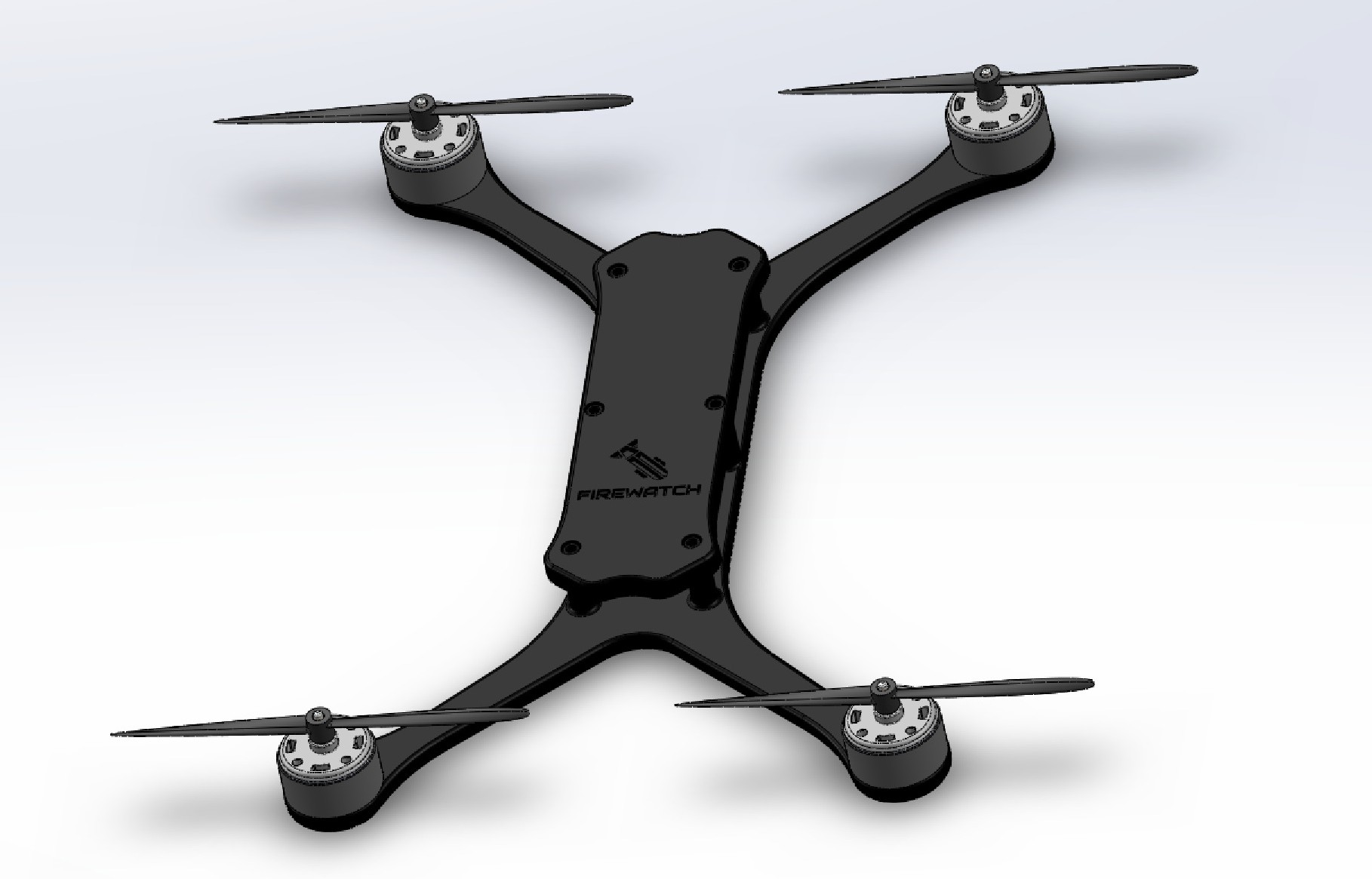
Tower-launched payload drone carrying fire suppressant. Designed for rapid autonomous deployment, guided flight to target zone, and coordinated release. Proprietary launcher interface is the subject of the provisional patent. First physical version currently in development.
WHERE THINGS
STAND TODAY
🛸
Mothership — Rev B
Rev A flew successfully. Rev B is underway — improved airframe, extended flight time, and refined command-and-control systems for coordinating larger drone fleets.
🤖
AI & Machine Learning
Software stack is operational. Onboard AI for fire mapping, perimeter detection, spread analysis, and autonomous flight path generation is set up and running on the mothership platform.
🚀
Suppression Drone — V1
First physical build of the suppression drone is actively in development. Mechanical design in SolidWorks. Launcher interface — the core patented architecture — is the primary engineering focus.
📋
IP & Patents
Provisional patent filed on the suppression drone and tower launcher system. Additional patents planned for the full system architecture and coordination methodology.
🗼
Tower System
Tower design concept defined — up to 100 suppression drones per tower, positioned throughout high-risk fire corridors. Physical design and integration engineering is a next phase deliverable.
🔥
The Goal
A fully autonomous, scalable wildfire response system that deploys in minutes, not hours — and gives human crews a fighting chance when fires are still small enough to manage.
WHY DRONES
CHANGE THIS
Instant Deployment
No crew briefing, no flight planning delays, no weather hold. Tower-launched drones are airborne within minutes of a fire call.
🗺️
Real-Time Mapping
The mothership's AI builds a live fire map that updates continuously — something no manned aircraft can provide at the same cost and persistence.
🔢
Overwhelming Numbers
100 drones per tower. Multiple towers per region. The system scales in a way that manned aircraft never can — more units means more suppressant on target, faster.
🛡️
Zero Human Risk
Initial suppression is fully autonomous. Human crews only engage after FireWatch has reduced the immediate danger and provided real-time intelligence.